

Learn how enzymes like Transglutaminase (TGase) and Glucose Oxidase (GOx) can effectively restore the quality of bug-damaged or moisture-affected wheat flour, improving dough strength, elasticity, and bread volume naturally.
The Challenge of Bug-Damaged Wheat
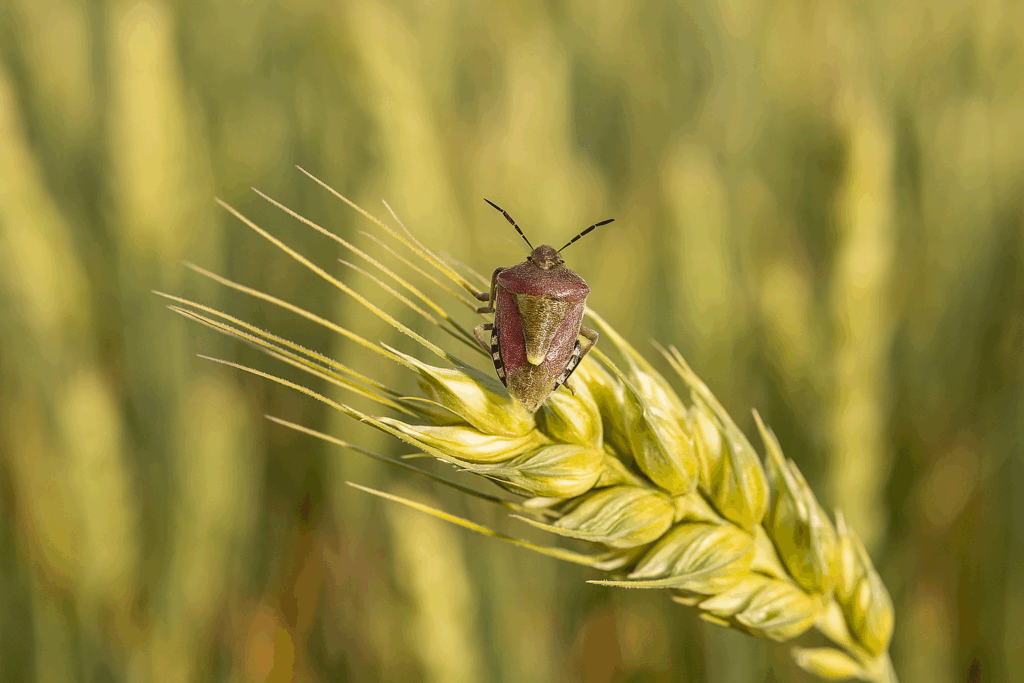
Bug-damaged wheat — known in the industry as sunn pest-damaged wheat — is a major problem affecting flour quality and bakery performance, especially in Middle Eastern countries like Iran.
This damage can occur due to:
- Sunn pest infestation (Eurygaster integriceps), which injects proteolytic enzymes into the grain, breaking down gluten proteins.
- Moisture or poor storage conditions, which activate endogenous wheat enzymes and lead to sprouting-like effects.
Both types of wheat damage result in weak gluten networks, sticky dough, and poor bread volume.
Fortunately, enzyme technology offers a natural, sustainable, and highly effective solution.
What Happens to Bug-Damaged Wheat Flour?
When wheat is damaged by pests or moisture:
- The gluten proteins partially degrade.
- Water absorption decreases, causing dough to lose elasticity.
- The dough becomes sticky and unstable.
- Final bread volume and texture are reduced.
This is a serious concern for industrial bakeries, mills, and pasta producers, as it leads to inconsistent product quality and higher rejection rates.
Enzymatic Solutions: TGase and GOx
Using enzymes instead of chemical improvers provides a clean-label, consumer-friendly approach.
Two of the most effective enzymes for repairing damaged flours are:
- Transglutaminase (TGase) — for rebuilding broken protein networks.
- Glucose Oxidase (GOx) — for strengthening and stabilizing gluten via oxidation.
Both are available commercially from Infinita Biotech under the trade names ECOENZYME-TG and ECOENZYME-GO, exclusively represented in Iran by Keemiya Mahour.
How Transglutaminase (TGase) Works
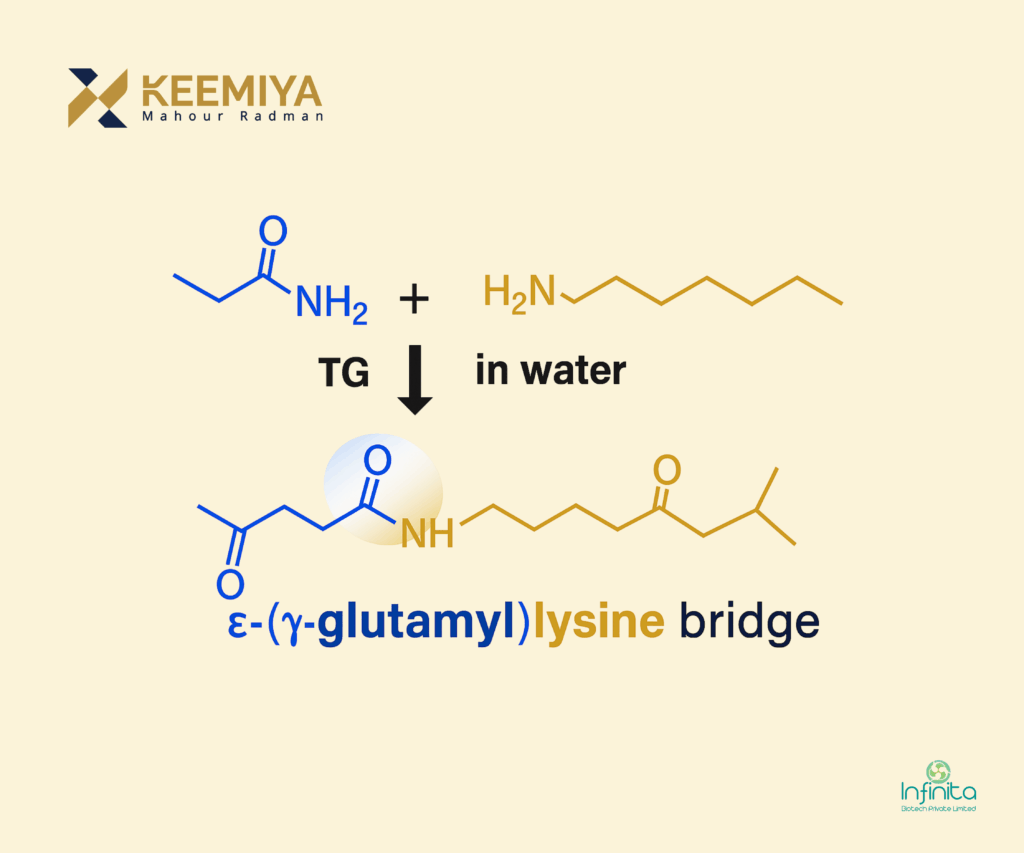
Transglutaminase (EC 2.3.2.13) catalyzes the formation of covalent bonds between the amide group of glutamine and the amine group of lysine residues in gluten proteins. The reaction is as follows:
Protein–Gln (–CONH₂) + Protein–Lys (–NH₂) → Protein–Gln–Lys (crosslink) + NH₃
This enzymatic crosslinking forms new ε-(γ-glutamyl)-lysine bonds, reinforcing the gluten structure.
As a result:
- Dough elasticity and stability increase.
- Water absorption improves.
- Bread volume and uniformity are enhanced.
TGase acts as a protein repair enzyme, ideal for pest-damaged wheat where gluten breakdown is severe.
How Glucose Oxidase (GOx) Works
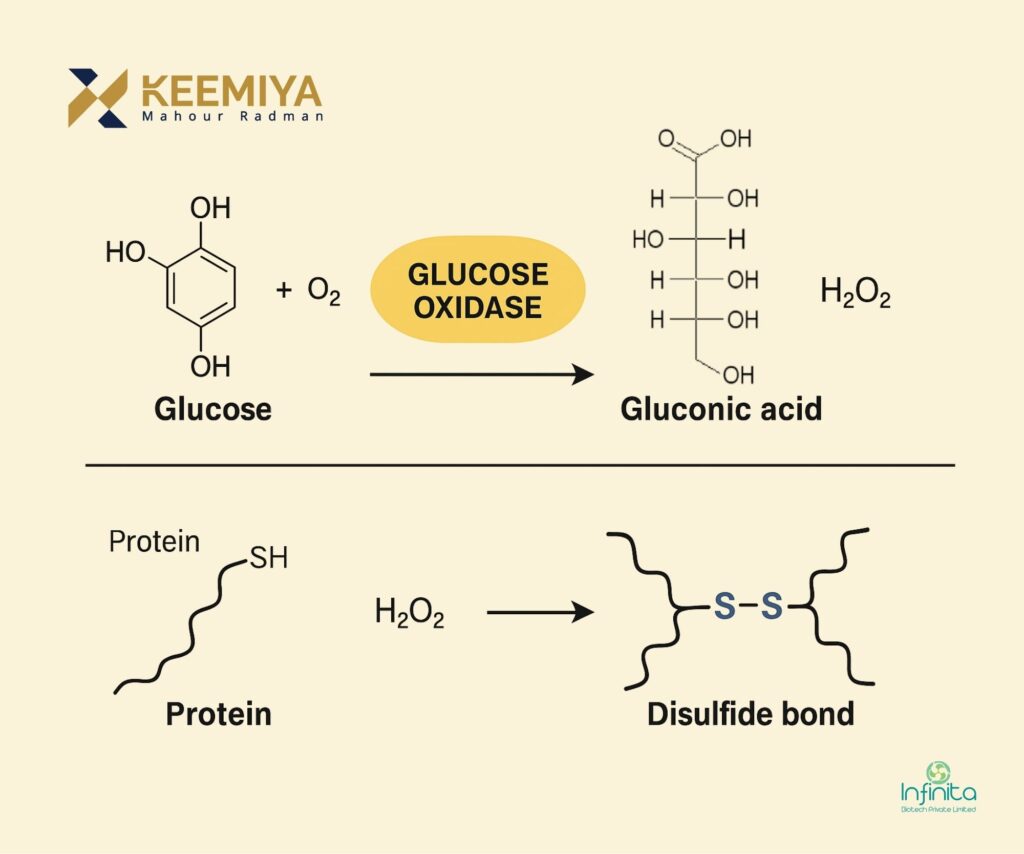
Glucose Oxidase (EC 1.1.3.4) catalyzes the oxidation of glucose to gluconic acid and hydrogen peroxide (H₂O₂). The reaction is as follows:
Glucose + O₂ → Gluconic acid + H₂O₂
The generated hydrogen peroxide then oxidizes thiol groups (–SH) on protein cysteine residues, forming disulfide bridges (–S–S–) that strengthen the gluten network.
Result: improved dough cohesiveness, mechanical strength, and better fermentation tolerance — especially beneficial for moisture-damaged or sprouted wheat.
Combined Enzymatic Application for Maximum Results
For severely damaged flours, combining both enzymes gives synergistic results:
- TGase repairs broken gluten chains.
- GOx strengthens and stabilizes them through oxidative bonding.
This combination is widely used in:
- Industrial bread production
- Flatbread and pizza dough
- Pasta and noodle processing
| Feature | TGase | GOx |
|---|---|---|
| Main Action | Crosslinks proteins via glutamine–lysine bonds | Forms disulfide bonds via H₂O₂ |
| Best for | Pest-damaged wheat | Moisture-damaged wheat |
| Effect on Water Absorption | Strong increase | Slight increase |
| Effect on Bread Volume | High improvement | Moderate improvement |
| Combined Benefit | Restores and stabilizes gluten network | — |
Why Choose Enzymatic Solutions Over Chemical Oxidants?
Unlike chemical oxidizers such as potassium bromate or ascorbic acid, enzymes are:
- 100% natural and food-safe
- Label-friendly and accepted in clean-label formulations
- Highly specific, with no negative side effects on flavor or color
Conclusion
Enzymes such as Transglutaminase (TGase) and Glucose Oxidase (GOx) are powerful biotechnological tools for improving bug-damaged wheat flour and restoring dough functionality naturally.
Using these enzymes, bakers and millers can:
- Improve dough elasticity and strength
- Increase bread volume and uniformity
- Enhance final product texture and shelf-life
In cooperation with Infinita Biotech, Keemiya Mahour provides high-quality enzymatic solutions such as ECOENZYME-TG and ECOENZYME-GO, enabling consistent and sustainable flour improvement across the baking industry.