Discover how baking enzymes such as protease, xylanase, and phospholipase are transforming semi-sweet biscuit and cracker production by replacing chemical additives with natural, efficient, and clean-label solutions.
The Shift Toward Clean-Label Baking
Modern bakeries face strong consumer demand for clean-label products—foods made with fewer chemicals and more natural ingredients.
In semi-sweet biscuits and crackers, chemical emulsifiers, reducing agents, and dough conditioners are being replaced by natural enzymes such as protease, Fungal Alfa amylase, xylanase, and phospholipase.
These biocatalysts enhance dough handling, spread, texture, and surface smoothness, all while maintaining the classic taste and crispness that define quality biscuits.
Explore ECOENZYME Baking Solutions
Why Use Enzymes Instead of Chemicals?
Traditional chemical agents like sodium metabisulphite, SSL, and DATEM are losing ground due to health perception and regulatory pressure.
Enzymes provide a natural, substrate-specific, and self-limiting alternative:
- They work precisely and in small doses.
- They are fully inactivated during baking.
- They reduce formulation complexity and improve process consistency.
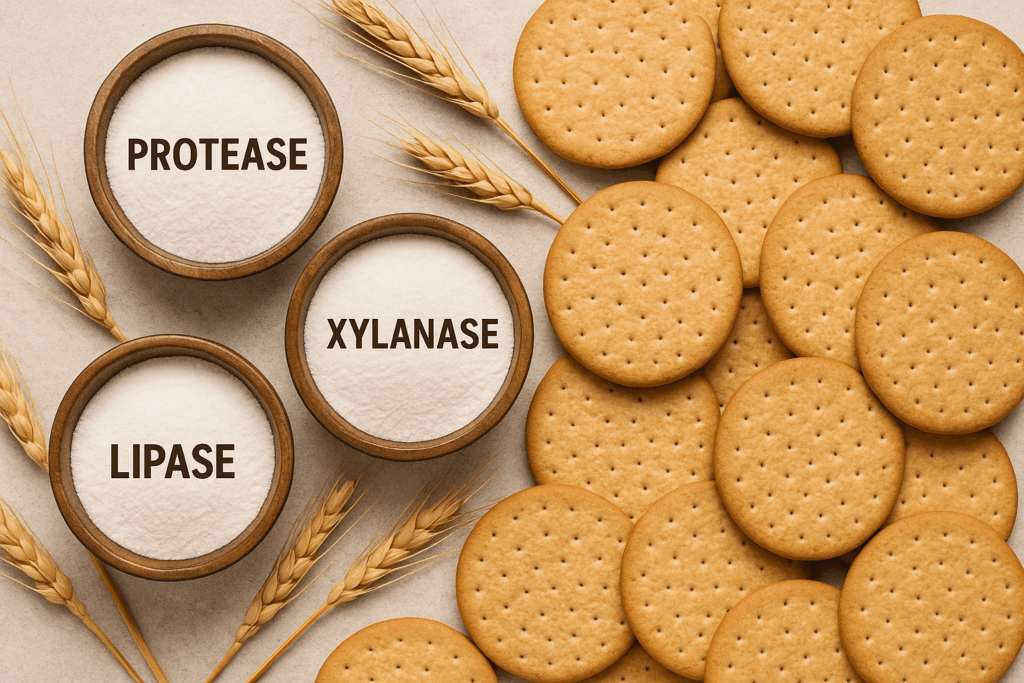
1. Protease (ECOENZYME-NP): The Natural Dough Relaxer
Function:
Proteases break down gluten proteins, softening the dough and improving extensibility. This enzyme reduces the need for chemical reducing agents traditionally used in semi-sweet biscuits like sodium metabisulphite (SMS).
Benefits:
- Replaces sulfite-based relaxers
- Improves dough machinability and sheeting
- Ensures consistent biscuit size and spread
- Creates a light, tender bite
Protease (ECOENZYME-NP) for Dough Relaxation
2. Xylanase (ECOENZYME-XYL F): The Texture and Spread Optimizer
Function:
Xylanase hydrolyzes arabinoxylans—non-starch polysaccharides that trap water and tighten the dough. By breaking these down, it enhances dough flow, extensibility, and uniform spread.
Benefits:
- Better dough sheetability
- Reduced breakage during cutting
- Controlled spread and surface texture
- Enhanced colour uniformity
Replaces:
Chemical dough conditioners and emulsifiers that improve dough structure.
3. Phospholipase (ECOENZYME-PL) — The Natural Emulsifier Generator
Function:
Phospholipase (e.g., Novozymes Lipopan F / Lipopan Xtra) hydrolyzes flour phospholipids and glycolipids into lysophospholipids—powerful natural emulsifiers.
These lysophospholipids improve the dispersion of fat in the dough, creating a smoother, more stable structure.
Benefits:
- Replaces chemical emulsifiers like DATEM and SSL
- Enhances dough cohesiveness and sheeting
- Improves spread control and surface finish
- Increases crispness and colour uniformity
- Supports a fully clean-label formulation
Phospholipase (ECOENZYME-PL) for Biscuit and Cracker Production
4. Fungal alfa amylase (ECOENZYME-FAA) – Enhanced Texture, Color and Bite
Fungal Alfa Amylase is another valuable enzyme in biscuit and cracker formulation. While protease, xylanase and phospholipase target protein, hemicellulases and lipids, fungal alfa amylase acts on starch, modifying its behavior during mixing, baking and storage.
Function:
Fungal Alfa Amylase hydrolyzes starch into smaller dextrins. In low-moisture baked goods like semi-sweet biscuits and crackers, this creates several desirable effects. By producing more dextrins, it improves Mailard browning. Small dextrins also make the surface more smooth and shiny. Fungal Alfa amylase also slightly improves tenderness and by moderating internal moisture movement, reduces stress lines and post-bake cracks. It also enhances flavor development by mild starch hydrolysis.
Benefits:
- mixing: creates mild dextrinization for smoother dough feel
- sheeting and cutting: reduces surface stress so fewer cracks and edge defects
- baking: promotes even browning & surface color control
- cooling: reduces moisture migration issues
- shelf life: delayes staling; maintains crispiness longer
How Enzymes Replace Traditional Chemical Additives
| Traditional Additive | Function | Enzyme Replacement | Natural Benefit |
|---|---|---|---|
| Sodium metabisulphite | Dough relaxer | Protease | Gentle gluten softening |
| DATEM / SSL | Emulsifier | Phospholipase | In-situ natural emulsifiers (lysophospholipids) |
| Dough conditioners | Texture and flow | Xylanase | Natural dough rheology improvement |
| Oxidants / improvers | Structure control | Enzyme synergy | Consistent texture and colour |
| Chemical Browning agents (caramel, malt extracts, added sugars) | Color & Surface shine | Fungal alfa amyalse | Natural dextrin & reducing sugar formation resulting in golden color |
| Chemical anti-staling agents | Crispness retention | Fungal alfa amyalse | Slower starch retrogradation so improved texture |
| Texture/brittleness modifiers | Surface smoothness | Fungal alfa amylase & phospholipase | Smoother texture, reduced cracking |
Benefits of Enzyme-Driven Biscuit Production
- Clean-Label Advantage: Shorter, consumer-friendly ingredient list.
- Process Efficiency: Consistent dough handling, fewer rejects.
- Cost Optimization: Reduced need for multiple chemical additives.
- Product Quality: Improved texture, colour, and shelf life.
- Sustainability: Enzymes are biodegradable and reduce chemical load.
Conclusion: A Smarter Path to Clean Biscuits
The use of Fungal alfa amyalse (ECOENZYME-FAA), protease (ECOENZYME-NP), xylanase (ECOENZYME-XYL F), and phospholipase (ECOENZYME-PL) in semi-sweet biscuit production marks a major step toward natural, efficient, and clean-label baking.
By replacing chemical relaxers and emulsifiers, enzymes not only deliver technical performance but also align with consumer expectations for healthier, chemical-free bakery products.
Cleaner biscuits, better dough, and a greener process — that’s the power of enzymes.