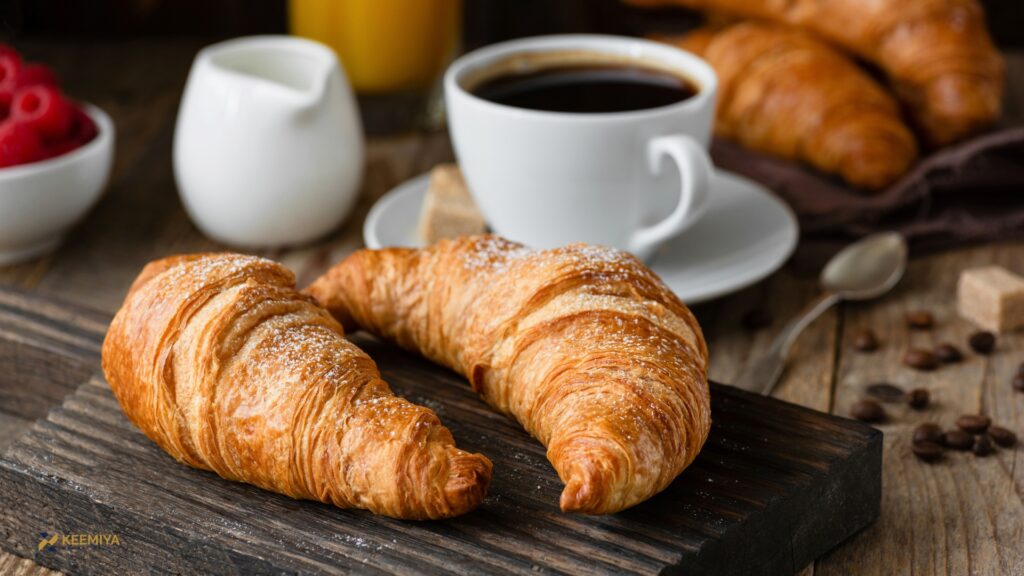
Croissants are a benchmark product for technical baking skill. Their quality depends on a fragile balance between dough rheology, lamination integrity, fermentation control, and freshness.
Small deviations in flour quality, processing energy, temperature, or fermentation can cause major defects including layer breakage, butter leakage, poor oven spring, dense or collapsed crumb and inconsistent batch-to-batch quality. Such defects cannot be solved by flour quality alone, as well as process optimization, enzymes play an important role to answer customer’s demand the best.
The Core Challenges in Croissant Production
The central challenge is achieving:
- Sufficient dough strength to retain gas and layers
- Enough extensibility to allow repeated sheeting
- Stable lamination through proofing, freezing, and baking
- Soft, open crumb that stays fresh over time
1. Dough Strength vs. Extensibility Conflict
Croissant dough must:
- Be strong enough to hold gas and layers
- Be extensible enough to sheet thin without tearing
If the dough is too strong, it shrinks so the layers break.
If the dough is too weak, it tears so butter leaks.
This balance is very difficult to control using flour quality alone.
2. Layer Stability During Lamination
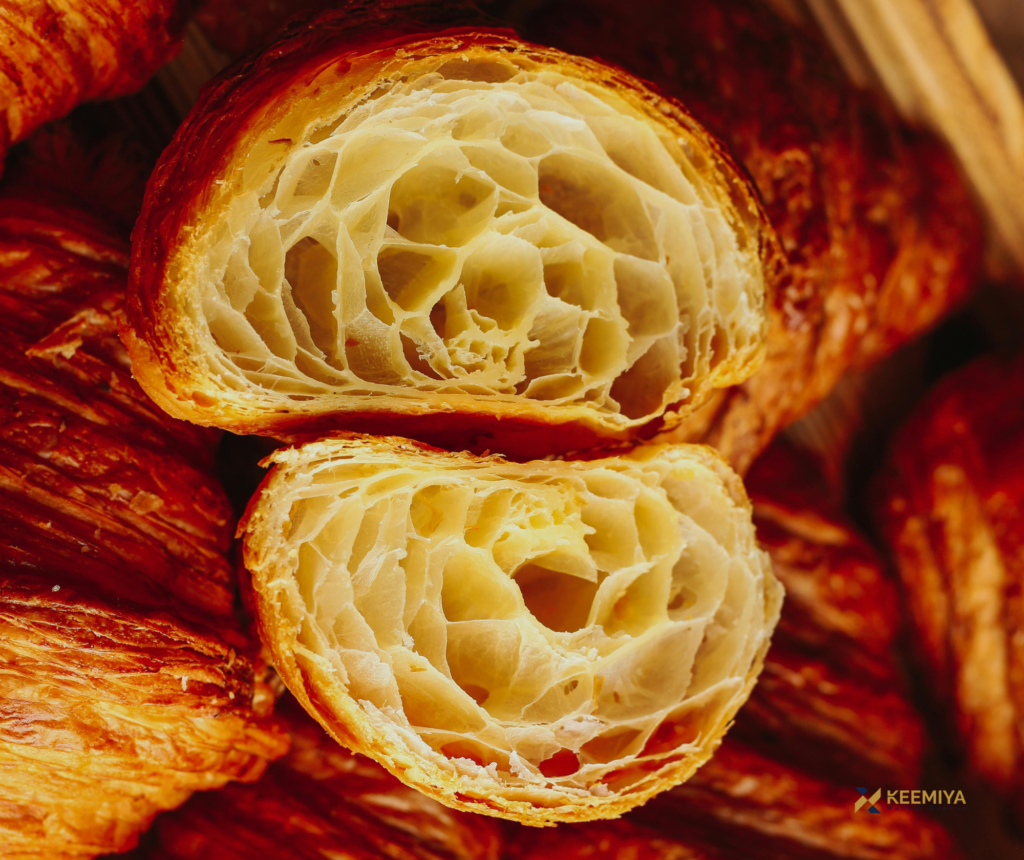
During multiple folds severe mechanical stress is delivered on gluten; gluten films are stretched to their limit, butter must remain discrete and any micro-tear leads to butter leakage and volume loss so common problems are micro-tearing of gluten films, butter migration into dough and loss of distinct lamination layers.
3. Fermentation Oven Spring Control
During proofing gas pressure expands the dough so unbalanced sugar release and gluten weakness cause irregular gas cell expansion, low oven spring and dense or uneven crumb.
Weak gluten collapses and on the other hand over-oxidation dries the dough surface which leads to irregular crumb and low volume.
4. Freshness and Shelf-Life (Especially in Bake-Off Products)
One of the most underestimated challenges is rapid crumb firming after baking, caused by starch retrogradation.
This is particularly critical for:
- Frozen dough croissants
- Par-baked croissants
- Retail bake-off formats
In frozen or par-baked croissants, ice crystals weaken gluten, re-fermentation becomes unpredictable and oven spring is reduced so it consistency becomes the biggest industrial challenge.
Why Traditional Chemical Solutions Are No Longer Enough
Historically, producers relied on chemical dough conditioners, emulsifiers (DATEM, SSL) and high-protein flours. But traditional chemical improvers can solve one issue while worsening another, reduce formulation flexibility And conflict with clean-label strategies.
This is where enzymes offer a targeted, process-driven solution; they act selectively and dynamically, adapting to dough conditions throughout processing.
How Enzymes Help Overcome Croissant Production Challenges
1. Protease (ECOENZYME-NP)– Controlled Dough Relaxation and Sheetability
Protease partially hydrolyzes gluten proteins so improves extensibility, reduces elastic snap-back and enables thinner, more stable layers. So it solves dough shrinkage and tearing during sheeting.
Key advantage:
Precise enzymatic action avoids over-weakening when dosed correctly.
2. Xylanase (ECOENZYME-XYL) – Strength Without Stiffness
Xylanase modifies arabinoxylans so improves water distribution, reinforces gluten network indirectly and enhances dough machinability so solves weak dough structure and poor gas retention which leads to stronger dough that still sheets easily.
3. Lipase / Phospholipase (ECOENZYME LIP/PL) – Natural Emulsification
These enzymes convert native flour lipids into natural emulsifiers that improve fat–gluten interaction and stabilize lamination layers so it solves layer instability and butter migration. They effectively replace or reduce chemical emulsifiers.
4. Amylase (Fungal α-Amylase – ECOENZYME FAA) – Fermentation Support
Amylase produces fermentable sugars which feed yeast consistently, improve oven spring and crust color. So it solves low volume, pale crust and weak fermentation. Amylase is particularly important in frozen and long fermentation processes.
5. Maltogenic Amylase (ECOENZYME-MA)– Freshness and Crumb Softness Control
Maltogenic amylase acts specifically on starch during baking and cooling producing maltose gradually, delaying amylopectin retrogradation and keeping crumb soft and elastic longer. So it solves rapid staling and crumb firming.
Key benefits in croissants:
- Extended freshness without gums or emulsifiers
- Improved eating quality in frozen and bake-off products
- More uniform crumb cell structure
This makes maltogenic amylase critical for modern croissant formats, especially retail and foodservice.
5. Glucose Oxidase (ECOENZYME-GO) / Transglutaminase (ECOENZYME-TG) – Structural Reinforcement
These enzymes strengthen gluten via oxidative or cross-linking mechanisms which then improve gas retention and increase tolerance to processing stress. So these enzymes can solve collapse during proofing or baking. They improve gas retention, process tolerance and shape stability but should be used carefully to stabilize structure without making dough rigid.
Enzymes vs. Traditional Chemical Improvers in Croissants
| Functional Need | Chemical Approach | Enzymatic Solution |
| Dough extensibility | Reducing agents | Protease (ECOENZYME-NP) |
| Dough strength | DATEM / SSL | Xylanase (ECOENZYME-XYL), GO (ECOENZYME-GO), TG (ECOENZYME-TG) |
| Emulsification | E-number emulsifiers | Lipase / Phospholipase (ECOENZYME LIP/PL) |
| Fermentation sugars | Added sugar | α-Amylase (ECOENZYME-FAA) |
| Freshness & softness | Gums, emulsifiers | Maltogenic amylase (ECOENZYME-MA) |
| Process tolerance | Flour blending | Enzyme systems |
Final Conclusion: Why Enzymes Are Essential for Modern Croissants
Enzymes vs. Traditional Chemical Improvers in Croissants
The true challenge in croissant production is not ingredients—it is process stability.
Enzymes:
- Work with flour biology
- Adapt to variability
- Deliver consistency across batches
- Enable clean-label formulations
- Improve lamination, volume, crumb, and shelf life simultaneously
For industrial and artisanal producers alike, enzymes are no longer optional tools—they are strategic solutions.